Faculty and Student Research
At EMU we believe that participation in original research projects is an important means of teaching scientific process and critical thinking skills.
Biology majors participate in faculty-led research projects as a means of learning by doing. Often students choose a specific project that falls within a larger, ongoing, research project in the laboratory of a faculty member. Students meet on a regular basis with faculty to discuss progress, and sometimes get together with other research groups to exchange ideas. In some cases, research results lead to presentations at national scientific meetings or publications in scientific journals.
Biology faculty also work closely with research projects in chemistry.
Stephen Cessna
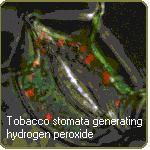 Plant Stress Physiology and Cellular Biochemistry
Plants in nature are continuously subject to several environmental insults, including drought, heat, cold, toxic pollution, disease, and insects. While some plants have evolved the ability to specifically combat one or more of these stresses (as cacti have special abilities to withstand drought), all plants have adaptive ability to tolerate most stresses to varying degrees.
My research focuses on the roles of metal ions, strong oxidants, and antioxidants in plant stress responses. Students working on this project may have the opportunity to learn several different laboratory techniques including: greenhouse maintenance of unique plants, fieldwork, measurements of photosynthesis and transpiration, and chemical spectroscopy.
STEM Education Research
Students learn a lot by doing research projects, and we expect a lot from them. However, what students gain from those experiences in a class is less clear. I am studying how well students accept and internalize learning in course-based research experiences, and what they feel they gain from such experiences.
Krisopher Schmidt
Cell Migration in Neural Development
Cell migration is essential for a wide variety of processes including the formation of the nervous system. Also, abnormal cell migration can contribute to important disease processes such as cancer. When neurons are born, they migrate sometimes long distances to precise positions where they undergo a process of differentiation, polarization, and extension. Several molecules have been uncovered that control the migration of neurons and the excretory cell along either dorsoventral or anteroposterior axes in developing organisms. Dr. Schmidt studies the gene unc-53/Nav2, a complex gene that acts as a relay between guidance molecules controlling neuronal navigation in the anteroposterior axis of C. elegans and the cytoskeleton of the cell. Current work employs a number of cell biological, genetic, and biochemical techniques to explore the function of unc-53/Nav2 and to understand the signal transduction pathways that it controls.
Regulation of Innate Immunity
In addition to studying neural development, Dr. Schmidt’s research extends to understanding the role of the unc-53/Nav2 gene in innate immunity within C. elegans. This gene plays a critical role in defending the organism against pathogens, particularly within the excretory cell, the worm's equivalent of the human kidney. The lab uses genetic approaches to investigate how unc-53/Nav2 regulates crucial pathways in both neurons and the excretory cell, especially during immune responses to infections like Pseudomonas aeruginosa. Their research has revealed that the loss of unc-53/Nav2 during infection leads to disruptions in key transporters responsible for fluid homeostasis and excretion-secretion processes. The team has shown that unc-53/Nav2 regulates the expression of aquaglyceroporin AQP-8, a protein vital for protecting the organism from hypertonic stress, which is essential for a successful immune response. By investigating these molecular pathways, Dr. Schmidt’s lab is not only advancing our understanding of C. elegans immunity but also modeling human kidney disease. This research could offer broader insights into the complex mechanisms of innate immunity and fluid balance across species.
Jim Yoder
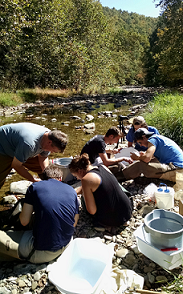 The Bergton Watershed Project: Stream Restoration and Biomonitoring
In the fall of 2014, I began a stream restoration and monitoring project in the German River and Crab Run watersheds near Bergton, VA. This is also a long-term collaborative project with initial funding provided by a grant from the National Fish and Wildlife Foundation (“Changing Agricultural Impacts on Shenandoah Headwaters”). The interdisciplinary project includes partnering with EMU biology department colleague Dr. Doug Graber Neufeld, Brian Wagner of Ecosystem Services, LLC., Dr. Tom Akre at the Smithsonian Conservation Biology Institute and EMU’s Center for Justice and Peacebuilding (CJP). The immediate goals of the project are to conduct a watershed assessment, restore two sections of stream and assess strategies to encourage adoption of best management practices by community members.
The project is an exceptional opportunity for a large team of our undergraduate Environmental Sustainability (ES) and Biology majors to learn stream restoration techniques with Ecosystem Services, community mapping and social research with CJP, water quality monitoring with Dr. Neufeld and ecological field techniques with myself. My students are specifically working on stream macroinvertebrate biomonitoring to measure restoration impacts and long-term population trends of Wood turtles in the watersheds. Current students leading research teams include Sam Stoner (ES, 2016), macroinvertebrate sampling and identification; Ryan Keiner (ES, 2016), turtle surveys and GIS; and Jesse Reist (ES, 2016), water quality monitoring.
Additional research team members during the fall of 2015 are Tyler Brenneman (ES, 2017), Austin Galbraith (ES, 2017), Meghan Good (ES, 2017), Dean Lowery (ES, 2017), Curtis Martin (ES 2017), Diana Mendoza (ES, 2017), Robert Propst (Biology, 2017), and Sarah Sutter (Biology, 2016).
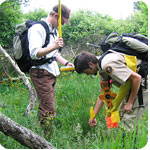 The Spread of Invasive Exotic Plant Species and Their Impact on Rare Plant Populations
in Shenandoah National Park
The Spread of Invasive Exotic Plant Species and Their Impact on Rare Plant Populations
in Shenandoah National Park
In the spring of 2006 I began a long term collaborative study working with Shenandoah National Park research botanist, Wendy Cass. The project addresses two specific research questions that focus on the exotic plants invading the Shenandoah National Park: 1) What is the rate of spread of the three most threatening exotic species invading the Big Meadows Swamp Natural Heritage area and 2) What is the impact of these exotics on the continued viability of the eight rare plant species located within the area?
Both of the questions are of intense interest to park biologists and land managers as well as contribute to the broader ecological study of exotic plant invasions of native ecosystems. Field data has been used for detailed analysis of rare plant populations as well as development of spatial models using GIS focused on threat and control strategies. Ongoing development of these models may be useful to predict future spread of exotics and subsequent impacts on ecologically sensitive areas within the park and throughout the region.
Research in the Teaching of Chemistry and Biology
Chemistry faculty Steve Cessna, Tara Kishbaugh, and Matt Siderhurst, along with Biology faculty Doug Graber Neufeld, JMU Psychology faculty Jeanne Horst, and Education faculty Lori Leaman were funded by a major NSF CCLI grant to promote the enhanced learning through authentic, relevant research experiences across the biology and chemistry curriculum. Through this project, the chemistry, biology, psychology, and education departments completed a unique interdisciplinary project that seeks to promote deeper, more practical learning of higher order cognitive skills (HOCs), the nature of science (NOS), and oral and written scientific communication skills. A description of the rubric developed to measure these skills