Faculty and Student Research
At EMU we believe that participation in original research projects is an important means of teaching scientific process and critical thinking skills.
Natural Sciences students participate in faculty-led research projects as a means of learning by doing. Often students choose a specific project that falls within a larger, ongoing, research project in the laboratory of a faculty member. Students meet on a regular basis with faculty to discuss progress, and sometimes get together with other research groups to exchange ideas. In some cases, research results lead to presentations at national scientific meetings or publications in scientific journals.
Stephen Cessna
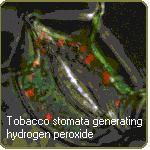 Plant Stress Physiology and Cellular Biochemistry
Plants in nature are continuously subject to several environmental insults, including drought, heat, cold, toxic pollution, disease, and insects. While some plants have evolved the ability to specifically combat one or more of these stresses (as cacti have special abilities to withstand drought), all plants have adaptive ability to tolerate most stresses to varying degrees.
Dr. Cessna's research focuses on the roles of metal ions, strong oxidants, and antioxidants in plant stress responses. Students working on this project may have the opportunity to learn several different laboratory techniques including: greenhouse maintenance of unique plants, fieldwork, measurements of photosynthesis and transpiration, and chemical spectroscopy.
Dr. Cessna and two EMU undergraduate published this article comparing the volatile compounds emitted from different spruce trees. Alexandra Raber is now an Internal Medicine Resident at the Ohio State University. Read more!
STEM Education Research
Students learn a lot by doing research projects, and we expect a lot from them. However, what students gain from those experiences in a class is less clear. Dr. Cessna is studying how well students accept and internalize learning in course-based research experiences, and what they feel they gain from such experiences.
Megan Moran
Dr. Moran's research focuses on wildlife population dynamics, with a particular emphasis on bats affected by White-nose Syndrome, a fungal disease that has caused substantial declines in bat populations across North America. She uses long-term acoustic monitoring and spatial modeling to investigate patterns of bat occupancy, activity, and persistence across the Northeast and Mid-Atlantic. Through this work, She is interested in understanding how bat populations are responding to disease and environmental conditions over time, as well as identifying areas where populations may be persisting or recovering. She is looking for students who are interested in getting involved in wildlife research and gaining experience with fieldwork, acoustic monitoring, data management, and/or quantitative analyses. Students with a variety of backgrounds and interests are welcome, and encouraged to look out for upcoming research opportunities!
Krisopher Schmidt
Microbial Genomics in Global Health Contexts
Part of Dr. Schmidt's research takes place in Peru, where he uses molecular approaches,
including genomics, to study antimicrobial resistance (AMR). His current work centers
on a Wellcome Trust–funded project that takes a "Genomics in Context" approach to
tracking AMR genes in the rivers and water sources used by Indigenous communities
in the Ucayali region of the Peruvian Amazon. A related project in the Piura region
of northern Peru uses similar molecular methods to study how microbial profiles in
local water sources vary with human individual and social factors.
At these and other sites, Dr. Schmidt works with field biologists, statisticians,
physicians, public health officials, and anthropologists. Some of this work also draws
on long-held Indigenous knowledge of local waterways and land use, alongside laboratory
data. In those cases, the communities help shape the questions, choose sampling sites,
and contribute to decisions about how the results are used. This is exciting work
if you are interested in public health and molecular biology, especially if you enjoy
working across cultures in interdisciplinary, collaborative teams.
Host-Pathogen Interactions using C. elegans
Dr. Schmidt’s research here at home uses the nematode C. elegans to dissect the molecular basis of host defense against bacterial infection. One project focuses on the excretory cell, a single-celled kidney that controls fluid balance. A second project aims to better understand the pathogenesis of the bacterium Elizabethkingia anophelis, an emerging, understudied, and sometimes fatal human pathogen. E. anophelis is common in the environment and usually harmless. In 2015–2016, however, a strain carrying a disrupted DNA repair gene, mutY, caused an outbreak in Wisconsin that resulted in 66 infections and several deaths. We are using C. elegans to examine how molecular changes like these affect the pathogenicity of E. anophelis. If you are excited about molecular biology and like the idea of working in the lab or at a computer, these projects might be right for you.
Jim Yoder
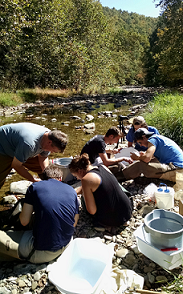 The Bergton Watershed Project: Stream Restoration and Biomonitoring
In the fall of 2014, I began a stream restoration and monitoring project in the German River and Crab Run watersheds near Bergton, VA. This is also a long-term collaborative project with initial funding provided by a grant from the National Fish and Wildlife Foundation (“Changing Agricultural Impacts on Shenandoah Headwaters”). The interdisciplinary project includes partnering with EMU biology department colleague Dr. Doug Graber Neufeld, Brian Wagner of Ecosystem Services, LLC., Dr. Tom Akre at the Smithsonian Conservation Biology Institute and EMU’s Center for Justice and Peacebuilding (CJP). The immediate goals of the project are to conduct a watershed assessment, restore two sections of stream and assess strategies to encourage adoption of best management practices by community members.
The project is an exceptional opportunity for a large team of our undergraduate Environmental Sustainability (ES) and Biology majors to learn stream restoration techniques with Ecosystem Services, community mapping and social research with CJP, water quality monitoring with Dr. Neufeld and ecological field techniques with myself. My students are specifically working on stream macroinvertebrate biomonitoring to measure restoration impacts and long-term population trends of Wood turtles in the watersheds. Current students leading research teams include Sam Stoner (ES, 2016), macroinvertebrate sampling and identification; Ryan Keiner (ES, 2016), turtle surveys and GIS; and Jesse Reist (ES, 2016), water quality monitoring.
Additional research team members during the fall of 2015 are Tyler Brenneman (ES, 2017), Austin Galbraith (ES, 2017), Meghan Good (ES, 2017), Dean Lowery (ES, 2017), Curtis Martin (ES 2017), Diana Mendoza (ES, 2017), Robert Propst (Biology, 2017), and Sarah Sutter (Biology, 2016).
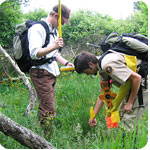 The Spread of Invasive Exotic Plant Species and Their Impact on Rare Plant Populations
in Shenandoah National Park
The Spread of Invasive Exotic Plant Species and Their Impact on Rare Plant Populations
in Shenandoah National Park
In the spring of 2006 I began a long term collaborative study working with Shenandoah National Park research botanist, Wendy Cass. The project addresses two specific research questions that focus on the exotic plants invading the Shenandoah National Park: 1) What is the rate of spread of the three most threatening exotic species invading the Big Meadows Swamp Natural Heritage area and 2) What is the impact of these exotics on the continued viability of the eight rare plant species located within the area?
Both of the questions are of intense interest to park biologists and land managers as well as contribute to the broader ecological study of exotic plant invasions of native ecosystems. Field data has been used for detailed analysis of rare plant populations as well as development of spatial models using GIS focused on threat and control strategies. Ongoing development of these models may be useful to predict future spread of exotics and subsequent impacts on ecologically sensitive areas within the park and throughout the region.